Young Builders in the Age of AI: A Student Perspective
I’ve been lucky enough to start college right at the beginning of the AI boom, and honestly, I don’t know what my college experience would’ve looked like without it. AI has helped me learn faster, build more creatively, and think way bigger about what’s possible.
A lot of people talk about AI like it’s going to replace jobs overnight, but I don’t really see it that way. Human intelligence is still far ahead. We’re the ones who bring judgment, creativity, and context. Where AI becomes powerful is when it fills in the gaps: helping us move quicker, explore ideas, and actually turn thoughts into real products.
Three years ago, building a software product could take months before you had anything working. Now, you can go from an idea to a prototype in a couple of hours. That speed changes everything, not because AI replaces people, but because it gives people leverage. At the end of the day, humans still have to be the deciders. The real opportunity is learning how to use AI as a tool to amplify what we can do, not something to be afraid of.
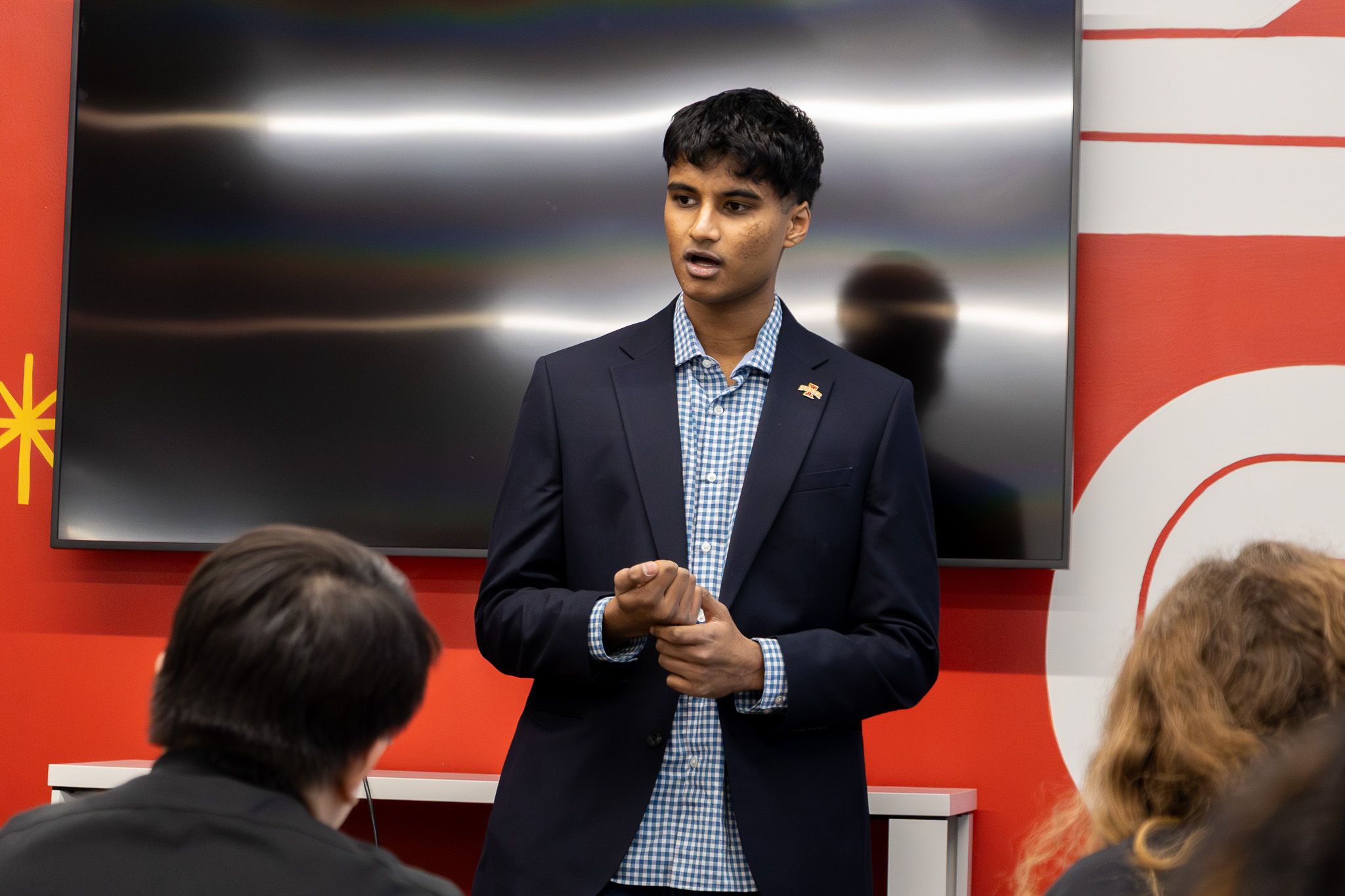
I’m Asray Gopa, a senior majoring in Computer Science at Iowa State, and I’ve gotten to use AI in pretty much every part of my life, professionally, in research, at hackathons, and even in my side businesses. I’ve used it for the boring stuff (emails, repetitive code, digging through resources) but also for the exciting stuff, like actually building things that didn’t feel possible as a college student a few years ago.
With AI, hackathons have become way more accessible. You can walk into a 24–48 hour competition with just an idea, and by the end of the weekend, you actually have something working. I’ve seen AI help teams get past the “stuck” moments instantly: setting up boilerplate code, debugging errors at 2 a.m., or figuring out some random API fast enough to ship a demo.
A few years ago, hackathons were mostly about who could code the fastest. Now it’s more about who can think creatively and build the smartest solution. I’ve literally watched people with no formal coding background, like music and communication majors, build apps with AI support, which is kind of insane in the best way.
AI has also completely changed the pace at which I learn and build day to day. I probably write more code in a week now than I would’ve written in a month earlier in college, even in languages I’ve never touched before. It’s not because I’m doing less work, it’s because the repetitive parts are automated, almost like having a pair programmer sitting next to you.
And in classes or research, if I’m stuck on a concept, I don’t have to wait for office hours or dig through ten different forums. I can ask AI for explanations and keep moving.
That speed is a huge reason I’ve been able to work on projects like Scalar News, where I’ve been building AI-powered tools that break overwhelming headlines into simple, digestible summaries. The goal is basically: what if the news was easier to understand, more personalized, and didn’t feel like scrolling through chaos all day? AI enables quick processing and explanation, but the human part is deciding what actually matters and how to present it responsibly.
I’ve also used AI heavily while building The Brik, my everyday-carry product startup. AI has helped me move faster across the entire process, from brainstorming features to writing code for the website, to generating marketing ideas, and even refining the way I communicate the story. It’s like having a tool that clears out the friction so I can focus more on building the product and less on getting stuck in repetitive work.
Even in research, I’ve worked on LoRa and sensor hub projects for agriculture, where AI and machine learning can help farmers detect issues in the field earlier, such as crop stress, pests, or environmental changes, and make better decisions with real data rather than guesswork. That’s what excites me most: AI isn’t just a chatbot thing, it’s showing up in real industries, solving real problems, even in places like rural Iowa.
The biggest thing I’ve learned through all of this is that AI doesn’t replace builders. It multiplies them. It gives students, researchers, and entrepreneurs leverage to create faster, test ideas sooner, and build things that would’ve taken entire teams just a few years ago.
The coolest part of being at the forefront of this boom is that my generation is the first to build careers alongside AI. Young people aren’t just adapting to these tools; they're shaping them. We’re actively shaping how they’ll be used in classrooms, workplaces, and entrepreneurship for decades.
That’s why it’s so important to center students and young adults in conversations about AI from the start. If these systems are designed without the input of the people who will rely on them most, we risk creating technology that doesn’t reflect how people actually learn, create, and grow.
At the same time, I don’t think the conversation should be framed as educators being “for” or “against” AI. I’ve seen so many teachers, administrators, and education-focused startups genuinely try to incorporate AI thoughtfully, and that effort is exciting.
The challenge is that everyone is kind of building the plane while flying it. Policies and tools are often made up on the spot, without enough collaboration with the actual end users. AI isn’t about shortcutting hard work; it’s about accelerating the feedback loop. It can help students explore ideas faster, debug sooner, and spend more time thinking critically instead of getting stuck on repetitive barriers.
The goal shouldn’t be to ban these tools or blindly adopt them, but to work alongside young people to understand where AI truly helps and how to use it responsibly.
At the end of the day, I’m genuinely excited for the future of AI, especially here in Iowa. A lot of people think the center of innovation has to be Silicon Valley, but I’ve seen firsthand that students and builders in Iowa are already using these tools to create real impact, whether that’s in agriculture, education, healthcare, or entrepreneurship.
AI gives people everywhere the ability to build faster, learn deeper, and turn ideas into reality in ways that weren’t possible before.
So I guess the real question isn’t “Will AI replace us?” It’s: how do we make sure the people using it, especially young builders, are the ones shaping what comes next?
Thank you,
Asray Gopa (He/Him/His)
Youth are the future.
Help provide youth with the opportunity to succeed.